sci-universe:
“Today, at the One World Observatory in New York City, Yuri Milner and I launched a mission to the stars. Mark Zuckerberg lent his support by joining the board of our new initiative, Breakthrough Starshot.
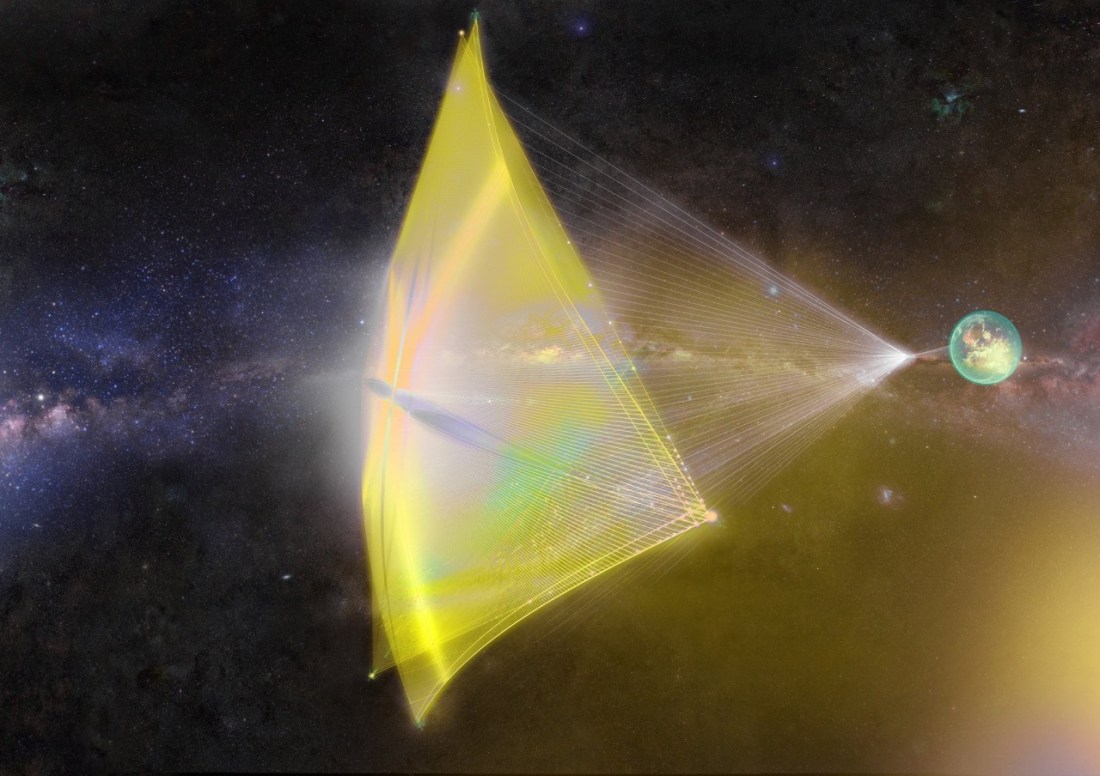
Within the next generation, Breakthrough Starshot aims to develop a ‘nanocraft’ – a gram-scale robotic space probe – and use a light beam to push it to 20 percent of the speed of light. If we are successful, a flyby mission could reach Alpha Centauri about 20 years after launch, and send back images of any planets discovered in the system.
Albert Einstein once imagined riding on a light beam, and his thought experiment led him to the theory of special relativity. A little over a century later, we have the chance to attain a significant fraction of that speed: 100 million miles an hour. Only by going that fast can we reach the stars on the time-scale of a human life.
It is exciting to be involved in such an ambitious project, pushing the boundaries of ingenuity and engineering. – SH“
The technology behind their ambitious proposal includes
nanocrafts, wafer-like computer chips, which would be “driven” by a meter-sized sail that weighs a couple of grams. The light sail will be propelled away from the Earth by an array of lasers, which Yuri Milner,
Russian entrepreneur and physicist, envisions carrying a combined power of over 100 Gigawatts (similar to the power needed to lift the Space Shuttle off Earth).
By directing that much energy at an object weighing just a few grams, we can theoretically accelerate said object up to 100,000,000 miles per hour—a thousand times faster than the fastest spacecraft today.
The project will be directed by Pete Worden, a former director of NASA’s Ames Research Center. He has a prominent cast of advisers, including the Harvard astronomer Avi Loeb as chairman; the British astronomer royal Martin Rees; the Nobel Prize-winning astronomer Saul Perlmutter, of the University of California, Berkeley and the mathematician Freeman Dyson, of the Institute for Advanced Study in Princeton, N.J.
It clearly has tough challenges but by putting the sharpest minds and money together, maybe we could actually travel to the stars this century?
I wish this would happen. But $100M is too little to make me think they are serious. $100M is like 1/7th of New Horizons mission to Pluto.
Or it’s like a single F-35 airplane plus three M1 Abrams tanks.
I wish the US, Russian, Chinese and Japanese governments would just synchronously defund their reciprocal budgets for, say, 10 fighter planes, 10 warships and 10 tanks each, and instead spend their money on this.





 tinfoilparachute