So now that North Koreans said that they are officially at war with us and will be shooting down US planes, should I just tell work that I will work from home from now on and be ready to take L home if I get a pop up alert that they followed through on their threat?

Last time they did we almost nuked them (http://www.npr.org/templates/story/story.php?storyId=128337461) and that was when they didn’t have the nukes and we had a grown-up at the White House.

There would be no time to get everyone including the cat and get out of the city but at least then we would be all together and die together when the the sh.t does hit the fan.

And if it does happen, it’s been nice knowing everyone on here and please make sure Trump does not escape unscathed from this.

newyorker:

“Sitting on the stoop is such a New York thing,” Kadir Nelson, the artist behind this week’s cover, says. He lives in Los Angeles but has fond memories of the Clinton Hill neighborhood of Brooklyn, from his days as a student at Pratt Institute. “Brownstones, stoops, leaves turning: that’s fall in New York, and I was also thinking about all the sweet moments I’ve had with my daughters.”

This was exactly the last weekend.

Brownstones are for rich people, so we just sat on someone else’s.

startswithabang:

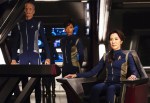
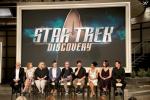
Star Trek: Discovery Analysis And Recap: Season 1, Episodes 1-2

“As visually stunning as this show is, it’s missing the one key element that’s been essential to every Star Trek incarnation since the beginning: hope. Star Trek has always brought us a hopeful view of the future, that we could overcome our present-day problems through not only technology, but through altruism and generosity and understanding. Even in times of war and conflict, there were hopes of peace. Those are the principles I want to see on display, and I want to see the characters in the show living up to them, not giving into their worst impulses. Sometimes, it takes making the wrong decision in a catastrophic fashion before you learn the lessons you need in order to get it right.”

The first two episodes of Star Trek: Discovery are now behind us, and while I expected it to be darker and more of a continuous story than a series of self-contained episodes, I think this was full of a lot of surprises, not all of them good. Yes, the visuals were absolutely stunning, from the sleek uniforms to the sets to the ships to the Klingons to the battle effects. The binary protoplanetary system was breathtaking. And this was a suspense-filled ride, with plenty of room for growth. But so many elements were missing. Character development was thin and inconsistent; is Michael Burnham a hothead who recklessly acts out whenever she doesn’t get her way, as we’re shown, or is she a cold and logical Vulcan-like person, as we’re told? Does the Federation champion diversity, or uniformity with just the veneer of diversity? And are the Klingons everything that islamophobes fear about Muslims, or are they simply falling for a theocratic demagogue peddling simple answers to complex problems?

There’s a lot to unpack and a lot more yet to come, but find out what my reaction was to the first two episodes of Star Trek: Discovery!

When I saw all those battles and explosions in the preview I knew it would be hopeless and had no intention to watch this new Star Trek.

new-aesthetic:

newdarkage:

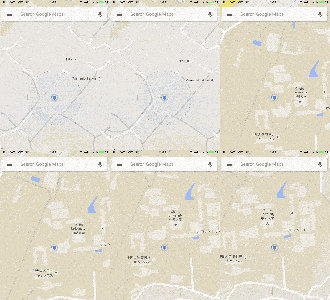
(via GPS freaking out? Maybe you’re too close to Putin)

After trawling through AIS data from recent years, evidence of spoofing becomes clear. Goward says GPS data has placed ships at three different airports and there have been other interesting anomalies. “We would find very large oil tankers who could travel at the maximum speed at 15 knots,” says Goward, who was formerly director for Marine Transportation Systems at the US Coast Guard. “Their AIS, which is powered by GPS, would be saying they had sped up to 60 to 65 knots for an hour and then suddenly stopped. They had done that several times.”

All of the evidence from the Black Sea points towards a co-ordinated attempt to disrupt GPS. A recently published report from NRK found that 24 vessels appeared at Gelendzhik airport around the same time as the Atria. When contacted, a US Coast Guard representative refused to comment on the incident, saying any GPS disruption that warranted further investigation would be passed onto the Department of Defence.

“It looks like a sophisticated attack, by somebody who knew what they were doing and were just testing the system,” Bonenberg says. Humphreys told NRK it “strongly” looks like a spoofing incident. Fire Eye’s Brubaker, agreed, saying the activity looked intentional. Goward is also confident that GPS were purposely disrupted. “What this case shows us is there are entities out there that are willing and eager to disrupt satellite navigation systems for whatever reason and they can do it over a fairly large area and in a sophisticated way,” he says. “They’re not just broadcasting a stronger signal and denying service this is worse they’re providing hazardously misleading information.”

When a tanker vanishes, all the evidence points to Russia