The Telescope to End All Telescopes: How we can finally photograph another world
“Ninthly, since the famous order of the elements is seen to be vain, the nature is deduced of these sensible compound bodies which as so many animals and worlds are in that spacious field which is the air or the heaven, or the void, in which are all those worlds which contain animals and inhabitants no less than can our own earth, since those worlds have no less virtue nor a nature different from that of our earth.” – Giordono Bruno
Humanity has speculated about the heavens for ages.
For a millennia we’ve looked up and imagined the gods above, waging war during thunder and crying during the rain.
Giordano Bruno, a Renaissance astronomer and friar, looked up into the heaven in which his God lived. The thought occurred to him that the stars… rather than being pinholes in heaven, may actually be something far more shocking:
Bruno realized they were Suns. The thought drove his idea that maybe, these stars had their own planets.
Naturally, he came to think: we aren’t alone.
He was burned alive in 1600 for his heretical views.
Fast forward to today:
Kepler 438b. Gliese 667Cc. Kepler 442b.
These are exoplanets. They’re real. We’ve just discovered them in the last few years. Many of you reading this will have been alive at a time when we had not yet discovered a single one (1992).
Can you imagine that? Centuries ago a man was executed for even imagining such an incredible thing. Now, we have all lived through his dream. We know it.
The Kepler mission has found 50%+ of the exoplanets alone. Yet even this amazing telescope delivers no images, just data.
If seeing is believing, “When,” one might ask, “will I see an actual photograph of an exoplanet?”
Well, as it happens: making a telescope isn’t easy. You need to create a mirror that is bent inwards like a bowl, which can then focus an image and reflect it to a small point, through which we then can either receive it on our instrument or view it through an eyepiece.
These mirrors, are expensive and tremendously difficult to create. They need to be accurate sometimes down to the nearest atom. Precision is absolutely key.
To this effect, a technique called ion figuring exists (and was used to create the Hubble Space Telescope).
Unbelievably, the European Southern Observatory is currently constructing what will be the world’s largest optical telescope: with a mirror at 39.3 meters in diameter, the European Extremely Large Telescope will be able to directly image exoplanetary gas giants.
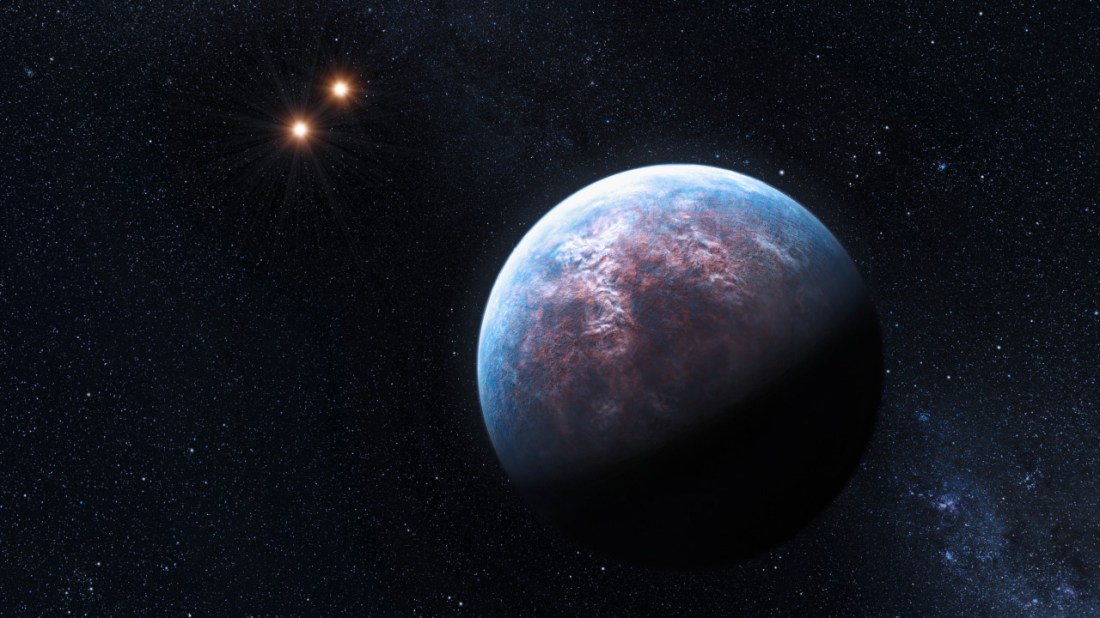
Even this gargantuan telescope, however, won’t give you the beautiful picture I’ve attached above.
So, back to the drawing board, you might ask, “Will we never then be able to see a photograph of an exoplanet?”
Notice I said the ESO is constructing the world’s largest optical telescope. There’s another way.
And we already have the telescope.
Einstein’s responsible (who else?) for showing us the way.
When he published his theories on general relativity, he realized that spacetime gets warped by mass. A large enough mass, he concluded, could bend space itself.
Bear with me.
When light travels across space and goes over a portion of warped space, it follows the curvature of space and it’s path of travel – its direction – is changed.
Something like a black hole, for example, might be so massive that it would alter the background of light we see around its edges. This phenomenon is known as gravitational lensing. Such a phenomenon looks like this:
What if I told you, 550 times farther from the Sun than Earth (called by astronomers “550 astronomical units”), there’s a place where this event actually happens. The Sun, as it happens, is just so massive that at this distance away (known as the gravitational focus point) our own local star so warps light that it actually bends its path into a focused point.
(Yes, astronomers, as Neil DeGrasse Tyson has pointed out, are straight up with our names (i.e. European Extremely Large Telescope, black hole etc.). We like to make them walk and talk like ducks.
Which is why I hate it when I go jogging and find a road called “Flattest Hill road” only to learn the hill’s a thousand times less flat than its name implies UGH)
So, and I did ask you to bear with me, now that I’ve told you the big secret, you probably want to know the specs: “How much detail could we see on an exoplanet’s surface?”
I hope you’re sitting down.
We could potentially resolve at a 1 km resolution.
Anything 1 kilometer and larger on the surface would be visible. That’s a little over 3000 feet in length.
What things are on Earth that you would be able to see with that resolution? A mountain. A city. The Golden Gate Bridge.
The only thing stopping us from using this natural telescope is ourselves.
(Image credit: ESO/L. Calçada and Wikimedia Commons users Urbane Legend(optimised for web use by Alain r) respectively)
NASA just shared this awesome photograph of “gravitational lensing” that I described above:
This is nicknamed the Cheshire Cat galaxy and it’s several galaxy images being warped by all the mass of dark matter in between them and us. Learn more here…
A team of astronomers just used the gravitational lensing technique from a quasar in another galaxy in order to magnify images of the stars in that galaxy.
It looks like they have just discovered, for the very first time EVER, extragalactic planets. Planets inanother galaxy! If that doesn’t make your jaw hit the floor nothing will.
The planets discovered include planets with a mass comparable to THE MOON and Jupiter. THE MOON. I am just totally geeking out right now. The galaxy is located 3.8 BILLION lightyears away!
Here’s an image from the article:
This image shows four lensed quasars (the white dots) and the lens galaxy in the center.
When I am able to get access to the actual article I will read it and probably have much more to say. In the meantime this says a tremendous amount for the sheer potential of what a gravitational lens-telescope could accomplish. Wow.


 tinfoilparachute