JULIA BARITZ IS having quite a week. The Austin-based developer is the founder and lead architect of Pillowfort.io, a community-oriented social media platform that’s quietly amassed around 20,000 users in its first two and a half years. But since Monday, Baritz has been inundated with more than 8,000 requests from people clamoring to join her site. Traffic to Pillowfort’s homepage has been 10 times higher than average, she says.
Baritz has porn to thank for this. On Monday, Tumblr announced a ban on all “adult content”, and creators have been frantically searching for a new place to migrate their NSFW art and porn blogs ever since. Pillowfort emerged as a potential safe harbor via word of mouth on social media; the site allows NSFW content to be posted with few restrictions, as long as it doesn’t break any laws.
“It’s funny that adult and sexual content has become the linchpin and turning point of our popularity in a way, but I’m not surprised,” adds Baritz.
Sexual content has always been a part of fandom communities online, from LiveJournal to Tumblr. These communities have a history of abandoning platforms that don’t support the free expression of adult material. It was LiveJournal’s crackdown on NSFW material back in 2007 that broke many users’ trust in the site and initiated the mass migration to Tumblr, along with the creation of fandom sites like An Archive of Our Own. Now Tumblr’s facing its own porn-related exodus, because NSFW content appears to be at odds with its business goals.
For Baritz, the experience has been head-spinning. Pillowfort is still in beta, and this situation has become a huge test for the site.
If anyone understands what Baritz has been going through, it’s Denise Paolucci. As the co-founder of Dreamwidth, a web 1.0-style blogging platform that shares Pillowfort’s user-first philosophy, she has seen a similar spike on her site this week. Dreamwidth is more established—it has existed since 2008 and has 53,595 active users (and 3,453,932 total accounts)—but traffic to the site also has surged by a factor of 10, she says. Many Tumblr users are tweeting about their plans to migrate to both Dreamwidth and Pillowfort.
Both sites adhere to an anti-advertising, anti-VC funding, anti-corporate model that is focused on user privacy, control, and freedom. That’s what makes them such appealing options to many disaffected Tumblr bloggers, but the challenges they face underscore why the dream of an independent web is so hard to achieve, even when there’s demand….
I have no NSFW content, and I barely have any on my feed, and what little is there, it is as beautiful as any art – it cannot qualify as porn. If it’s gone, I will surely miss it, but then, going back to thinking – why do I have this blog at all – losing its continuity might not be worth moving to WordPress, Pillowfort or Medium. And – no Instagram or Twitter for me out of principle. So, as much as I’ll miss those who leave, I will not be leaving. Not yet.
Yahoo is a notorious repeat offender. Yahoo is the reason the “if you’re not paying money for a service, then you’re not a customer, you’re the product.” saying exists.
Here is some fully general advice: If you’re the user of a free-to-use website, and you learn that it’s being bought by a large company, then this is always, and forever, bad news. If it’s not an acquihire, then it’s something worse. You’re not a customer, you’re the product.
If we’re lucky, this will be a Livejournal-style buyout, where the site just gradually disintegrates over the course of several years. If we’re unlucky, then it’ll be a Posterous-style buyout, and Tumblr will be shut down when Yahoo goes bankrupt in six months. It is vanishingly unlikely that being owned by Yahoo will benefit Tumblr users at all.
Predictions:
More ads. Karp has a weirdly principled dislike of ads, for a guy running a free social network. Marissa Mayer is unencumbered by morals, here. If you spend a billion dollars on something, you’re gonna want a return on income.
NSFW content is probably going to be banned, or heavily restricted. (As in, “verify your age by giving us a credit card number”) Ad networks hate and fear porn, and Yahoo is going to run more ads. No other Yahoo property allows NSFW content, for precisely this reason.
They might try to restrict fan content, due to copyright/CP concerns, as Livejournal did; they might not.
Dogs and cats living together. Mass hysteria!
I called it, five years in advance.
The prophecy was right there and we all ignored it.
Wow
*It didn’t take Nostradamus to figure that one out.
Well, it did take 5 years. And it outlasted Marisa Meyer and Yahoo, and even a couple of years of Verizon/Oath.
We always knew it was a matter of time, but big corporations move slowly, and it took Karp’s departure and Apple banning it from App Store to ultimately cause this.
Many places have a “forest that shouldn’t be entered.” Even people who are used to working in the mountains feel there is something there. They are suddenly overcome with fear and it becomes the custom to avoid certain places. These places exist. I don’t know what is there, but I think they are real. I’m not a believer in the occult, but the world is more than we can fathom with our five senses. This world doesn’t exist just for humans. So I think it’s all right to have such things. This is why I think it’s a mistake to think about nature from the idea of efficiency, that forests should be preserved because they are essential for human beings …
I am concerned, because for me the deep forest is connected in some way to the darkness deep in my heart. I feel that if it is erased, then the darkness inside my heart would also disappear, and my existence would grow shallow.
Hayao Miyazaki, “Totoro Was Not Made as a Nostalgia Piece”, Starting Point: 1979-1996
A new tool by ThingsCon in Berlin will help consumers identify which devices truly respect their privacy and security starting 6 December 2018.
Every day, millions of consumers rely on trustmarks to make informed purchases. These simple icons convey critical information, like whether or not food is organic, automobiles are safe, or bank accounts are insured.
Yet many of the internet-connected devices we buy — from AI speakers and wearables to smart toys for kids — don’t have trustmarks. It can be incredibly difficult to truly assess products’ privacy and security features. As a result, consumers are largely in the dark about whether or not an IoT device will respect their personal data.
So today, ThingsCon is launching the Trustable Technology Mark: A tool for consumers to assess whether an IoT device truly respects their privacy and security. It’s also a tool for companies to show their products are trustworthy.
Says Peter Bihr, ThingsCon co-founder and a Mozilla Fellow leading the Trustable Technology Mark initiative: “IoT devices are only becoming more widespread and more advanced — they live in our kitchens and bedrooms, and they access our calendars and our conversations. As a result, consumers should have answers to important questions like What personal data does this product collect? How is that data stored? Who has access to that data? And Can I easily export that data?”
The Trustable Technology Mark answers these questions. To earn the mark, IoT products are evaluated using five criteria:
Privacy & Data Practices: Is it designed using state of the art data practices, and respectful of user rights?
Transparency: Is it made clear to users what the device does and how data might be used?
Security: Is it designed and built using state of the art security practices and safeguards?
Stability: How robust is the device and how long of a life cycle can a consumer reasonably expect?
Openness: How open are both the device and the manufacturer’s processes? Is open data used or generated?
Trustable Technology Mark evaluations are carried out by neutral experts at ThingsCon, a collective of engineers, designers, and researchers who are devoted to more responsible IoT. ThingsCon is based in Berlin, Germany, and conducts research, hosts conferences, provides fellowships, and more.
Any device maker is welcome to complete a thorough self-assessment and submit it for evaluation. The results of these self-assessments are published in full under an open license as part of the Trustable Technology Mark certification requirements.
The evaluation process is rigorous. But the end result is convenient and straightforward for consumers — when a product passes review, the Trustable Technology Mark icon can be featured on its web page or packaging.
The mark is launching with proof of concept in two categories: voice assistants and connected toys. snips.ai, a smart voice assistant from France, and Vai Kai, a connected toy from Germany, have already qualified for the mark.
Says Dr. Rand Hindi, CEO and cofounder of Snips: “This qualification is a true recognition of the great work conducted by Snips team over the last year. I am extremely proud of it. Our belief is that by running their voice assistant on the Edge and totally offline rather than in the Cloud, companies can guarantee Privacy by Design, without compromising on performance, brand or user experience.”
Says Justyna Zubrycka, co-founder and CDO of Vai Kai: “It is the core value of Vai Kai company to provide safe and high quality connected products for especially sensitive period of human development that is an early childhood. One of the basic principle of our design is that toys don’t collect any personal user’s data. All the digital advantages are there to support child’s development, and to help us constantly improve our products. We see Technology Mark as an extremely important initiative that promotes connected technology created with these values upfront.”
The mark also has the support of several academic and policy partners, including ITS Rio, NYU Technology Law & Policy Clinic, CIS India, BiLGi Information Technology Law Institute, Shenzhen Open Innovation Lab, University of Dundee, Centrum Cyfrowe, and Technical University of Dresden’s Institute of Media and Communication. These partners will promote the Trustable Technology Mark in their curriculum, publications, and events.
Say Jon Rogers, Mozilla Fellow and Professor of Creative Technology at University of Dundee: “At a time when the Internet of Things is becoming a powerful force for almost every aspect of our lives — on our bodies, in our homes and across our cities — we have to ask the question ‘do we trust it?’ I wouldn’t take medicines that didn’t come with a clear trusted label; I wouldn’t buy a car that didn’t come with documents telling me who had owned it and if it was safe. Yet, the things we’re buying that connect us, our family and our friends directly to the internet 24 hours a day, 365 days a week currently have almost no way to visibly and say ‘you can trust this.’ This is why the Trustable Technology Mark is so important.”
The release of the Trustable Technology Mark comes on the heels of deep research and network building by ThingsCon. In 2017, ThingsCon published “A Trustmark for IoT,” a thorough examination of the potentials and challenges of an IoT trustmark. ThingsCon has also developed a guiding Theory of Trust. Progress has been thoroughly documented through blogs, and the initiative’s development has garnered coverage in the Wall Street Journal, Offscreen Mag, the Internet Health Report, and other publications.
Companies may submit their products for evaluation beginning December 6. To do so, visit https://trustabletech.org/apply/. ThingsCon will begin administering Trustable Technology Marks in early 2019.
ABOUT THINGSCON
ThingsCon is a global community and event platform for IoT practitioners. Its mission is to foster the creation of a human-centric and responsible Internet of Things (IoT). Through events, research, publications and other initiatives, ThingsCon provides practitioners with an open environment for reflection & collaborative action. https://www.thingscon.org
ABOUT MOZILLA
Mozilla believes the internet must always remain a global public resource, open and accessible to all. Our work is guided by the Mozilla Manifesto. Mozilla focuses on fueling the movement for a healthy internet by supporting fellows working on key internet issues; connecting open internet leaders at events like MozFest; publishing critical research in the Internet Health Report; and rallying citizens around advocacy issues.
Freedom has ended nothing. It is a beginning. Freedom is not peace. We have enjoyed our victory but have yet to see the victory of all. And we now know that all we have won is the right to go on fighting.
Albert Camus, Camus at Combat (September 29, 1944)
Swirling snow drifts accent the terrain surrounding the Dnieper River, which flows for roughly 1,400 miles (2,200 km) from Russia to the Black Sea. The Dnieper is the longest river in the Ukraine and Belarus, and the fourth-longest river in Europe. This amazing image was captured by European Space Agency astronaut Thomas Pesquet while aboard the International Space Station in February 2017.
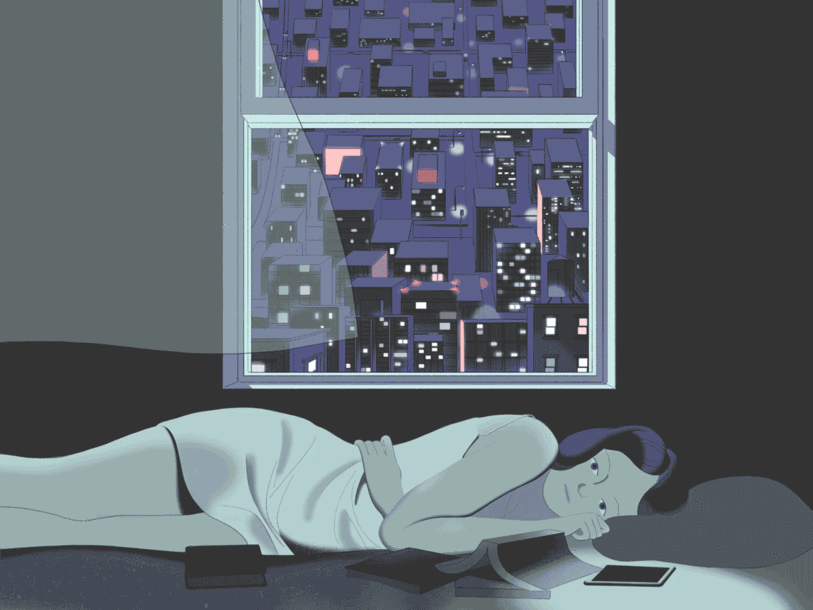
Many contemporary sleep evangelizers seem to have the misleading and slightly infuriating impression that getting enough sleep is a life-style choice, a free resource, available to all who care enough to make it a priority. It is a beguiling idea, that one might transform one’s sleep, and the rest of one’s life, with a few virtuous acts of renunciation—no electronics in the bedroom, no coffee after 2 p.m.—and a few dreamy self-care rituals involving baths and tea. But some of the leading indicators for poor sleep and sleep loss are low household income, shift work, food insecurity, and being African-American or Hispanic. Getting enough sleep is not a simple task, it seems.’




 tinfoilparachute