David Van Reybrouck thinks we should return democracy to its roots, and select our political officials by lottery. Couldn’t be worse than what we have now.https://t.co/UTkXM3Guc4pic.twitter.com/vpYzROkuww
I did not hear his talk at Bard, and as interesting as a thought experiment it would be, I wonder if he addressed the real-world sociological precedent that we already have – both the jury trial (that everyone does their best to get out of, and often does), and the grand-jury indictment process (that is nearly impossible to get out of).
So, take a bunch of randomly selected people who put their careers on hold against their will (jury), give them massively more power, add appointed officials (judges, prosecutors), lobbyists (lawyers) and career bureaucrats with ententched interests (police, prison workers and corporations that run them), and see what happens.
Note: This unearthed BLUG was supposed to appear in 2017. Still relevant tho. Have a great day!
The 2017 Rivendell ROADINI
In the mid-1970s just
three kinds of bikes —road, “sport-touring,” and actual touring—covered all
kinds of riding. The difference was tire size, tube beefiness, and gearing.
If you had only a road bike, you could mount 32mm tires and
a rack and go on a credit card tour. If you had a touring bike, you could strip
the racks, ride lighter tires, and sprint with the club. There wasn’t a world of difference–if you weren’t into bikes you couldn’t even tell. The “sport-touring” bike
was kind of the hair-splitting hybrid.
When the ‘80s mtn bike & its lite variants took over
comfortable & practical riding, the road bike retreated to extremism and
hasn’t recovered. Today’s typical road bike is suitable only for
head-down/follow-the-butt riding on dry and smooth roads. Years of tech-chasing
and weight wars have sucked the sense out of it.
The handlebar is too low, so it’s uncomfortable. The skinny
tires and no fenders rule out rough or wet roads. It’s a nervous handful in the
wind or on a fast descent. You can learn to tame it, but it’s always on the
edge of something bad or funky—a crash that’s not entirely your fault, a fender
install it rejects, a tire you have to return, a responsiveness that’s too much. You want the bike to forgive minor steering or judgment flubs, and to not flip out when you roll over or hit things road debris or small potholes.
And, if it’s carbon fiber, a hidden manufacturing flaw
or a wound picked up along the way is a potential sudden failure. On paper,
carbon looks like the best material in the land. But carbon bikes have a dismal
record of sudden failures and life-changing injuries to their riders. This
isn’t fear-mongering; it’s a carbon fiber fact. Carbon is popular because most
road bike riders can’t see past tech and weight and what the pros are paid to
ride .
Our all-lugged
CrMo steel road bike — the $4,200 Roadeo, is an excellent alternative.
It’s far more versatile than a modern road bike and will last ten times as
long, and can’t fail suddenly. Steel doesn’t do that. It’s closer to the early
‘70s road bikes, but has benefitted from 40 years of materials, design, and
construction progress. But $4,200 rules out lots of riders.
If most of your riding is carrying something and going
somewhere, you might still want a sporty bike for solo or group road rides that
finish at the coffee place. And maybe you want variety, but your budget’s
$2,200 to $2,500. You should be able to get something for that, right?
In 2015 we sketched out a bike with the ride of the Roadeo
and all the qualties a road bike should have. It’s safe, comfortable, good for
all roads & weather, and fun to ride. This June we’ll have it: the
Italian-sounding ROADINI.
Roadeo vs ROADINI
1. The Roadeo has lighter tubes, but ROADINI’s tubes are
light enough. They’re our own SILVER design, but we’ve chopped from the
big-butted ends to minimize weight. It’s probably slightly stronger than
necessary.
2. The same tire clearances —up to a 35mm with no fenders,
and easily a 28mm w/fenders.
3. ROADINI’s chainstays are a hair longer than the Roadeo’s
(which are already longer than most)—so it’s more stable, but still zippy.
4. The ROADINI top tube slopes up more, so it’s easier to
get the bars high. Your ROADINI size is 2-3cm smaller than your Roadeo size.
5. The Roadeo frame is made in America and is all lugged,
which makes it our flagship road bike. The ROADINI frame is made in Taiwan, is
tig-welded except for a seat lug, weighs a few ounces more, and costs $1,450
less.
The ROADINI’s seat lug has the swirly beauty of our other
seat lugs, and a new way of attaching seat stays that makes a gorgeous joint,
rock solid. It may take some familiarity with compression and sheer to fully
appreciate, though.
6. The Roadeo & ROADINI forks have the same crown, material
quality, construction quality, and good looks. The Roadeo fork is made in
America; the ROADINI fork is made in Taiwan.
the roadini is an all-around, all-weather road bike. It
gives up nothing to modern extreme bikes on smooth, ideal roads, and is far
better in every way when conditions are crappy. It has the classical clearances
of the oldies, higher quality overall construction, is more comfortable, and
rides like a Rivendell.
If up to now you’ve avoided road bikes because they’re so
weird, extreme, and expensive, now there’s one that isn’t. This year we’re
making just over 100 frames in 5 sizes (listed below) expected early this fall. We have a second run scheduled for early next year.
The front height of this crown happens to be 19mm. With a
std vertically centered hold, both numbers would be 9.5mm. You want that extra
3.5mm to be air, not fork crown, so when you try to stuff a slightly bigger
tire or a fender under there, it hits air and fits and rolls on through. it’s not jammed up against the underside of the fork crown.
The ball-and-socket seat stay joint eliminates sheer forces
and adds strength. The main shoreline of the seat lug is familiarly Rivendell,
the same-ish swirls and all, and like all Rivendell seat lugs, it has other
obsessive details that — well, if you’re going to make it from scratch, might
as well be there—
The large, raised and reinforced stress relief hold reduced
to basically impossible the chance of repeated tightenings causing a stress
crack at the bottom of the slot. Admittedly, it’s not a common occurrence, but
we’ve seen it happen on other bikes half a dozen times. We make it maximally
crack-resistant on our seat lugs because our showroom bikes get tightened and
loosened and retightened with ever test ride, every slight difference in saddle
height. On your bike, maybe you’ll do it a few times in the fussing, so our
O-hole is overkill, but it’s also a nice visual detail.
The seat binder area is reinforced with unpinchable steel.
As with the O-hole, it makes our lug impervious to repetitive stress.
Also—little known fact here—the super strength and flat ears
make it Vise-Grip compatible. So if you lose or break a seat binder bolt and
you have a Vise-Grip, you can safely clamp down on it with that, and you may
foul the paint, but you won’t hurt the lug.
If you happen to break or lose a binder bolt—maybt it
rattles loose on a packed bike and you throw it out with the box and discover
its goneness too late—you can replace it with the same standard M6 x 20 to 22mm
bolt and matching 10mm nut from any hardware store on earth.
In a pinch, you can use a any bolt that fits through the
hole, and a wild combo or spacers or washers. We are NOT saying do this, or
that we’ve ever had to. The point is that when we designed this seat lug, this
was one of the criteria. An overreaction to having been frustrated by seat lugs
(including our earliest ones, and almost all Italian and Japanese seat lugs)
that require their own weirdo binder bolts.
frame vitals
sizes—47 (650B); 50, 54, 57, 61 (700C)
two colors: blue, gray.
compatibility: Quill stem, 1-inch threaded headset (30.2 x
26.4), 130mm rear wheel, 31.8 front der., 26.8mm Seat post.
Frame & fork (no parts):
$800.
sizing by pbh or saddle height
PBH Saddle ht roadini size
74.5-77.5 63.5-66.5 47 (650B)
77-83 66-72 50
82-87 71-76 54
85-90 75-79 57
89-96 78-85 61
This assumes you’re not comfortable on a modern road bike
with a “bike shop fit.” But if you’re a young gumby and like lowish bars, you
can ride down a size. A Roadini has the bar-height of a much bigger typical
modern bike—so it’s more comfortable.
BUILD options
1. riv trad. Non-brifter shifting ,and parts we’ve used
forever. 32-spoke wheels. Lots of flexibility, talk to us, we’ll help you nail
it. About $1,500 for parts.
2. riv mod. We will get you the best of
Shimano non-electroid brifter shifting within your budget. Some flexibility.
Typically $1,600-$1,800 for parts, but the frame is worthy of whatever you put
into it.
3. part / full rogue. Good if you have some parts already
and you want the new stuff to be compatible with it. We’re happy to advise, but
you’ve got to ask.
Those tires though!!
I can’t afford a whole Rivendell bike, but at least I got the tires (from Rivendell!) for the Buena Vista I built for R from the b-stock Soma frame brought back as a souvenir from SF.
And now it’s getting covered with dust in friends’ basement because there is no bloody storage in this building and our apartment is too small for anything! Hoping that some day we’d live in a place that has indoors space for a bike or two, but whom are we kidding?
“What we can learn from the errors of machine learning is that we do not have to live according to a set of rules that produces obviously unfair and undesirable outcomes like a bloated one percent, apartheid prisons, and the single worst person in the country as president. ”
“America exists to create wealth, and the system isn’t broken, it’s just obeying the rules to disaster; as a country, we’re more ourselves than ever.”
I never thought of imagining our liberal market economy as a form of AI, but of course it is – and everything good and bad that comes out of it can be both a bug and a feature. The problem of fixing the bugs in the face of active resistance of the buggy system is probably one of the hardest ones that we need to somehow solve.
Machine learning algorithms are not like other computer programs. In the usual sort of programming, a human programmer tells the computer exactly what to do. In machine learning, the human programmer merely gives the algorithm the problem to be solved, and through trial-and-error the algorithm has to figure out how to solve it.
This often works really well – machine learning algorithms are widely used for facial recognition, language translation, financial modeling, image recognition, and ad delivery. If you’ve been online today, you’ve probably interacted with a machine learning algorithm.
But it doesn’t always work well. Sometimes the programmer will think the algorithm is doing really well, only to look closer and discover it’s solved an entirely different problem from the one the programmer intended. For example, I looked earlier at an image recognition algorithm that was supposed to recognize sheep but learned to recognize grass instead, and kept labeling empty green fields as containing sheep.
When machine learning algorithms solve problems in unexpected ways, programmers find them, okay yes, annoying sometimes, but often purely delightful.
So delightful, in fact, that in 2018 a group of researchers wrote a fascinating paper that collected dozens of anecdotes that “elicited surprise and wonder from the researchers studying them”. The paper is well worth reading, as are the original references, but here are several of my favorite examples.
Bending the rules to win
First, there’s a long tradition of using simulated creatures to study how different forms of locomotion might have evolved, or to come up with new ways for robots to walk.
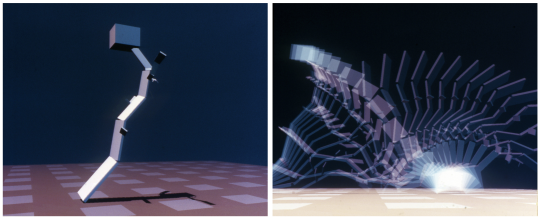
Why walk when you can flop? In one example, a simulated robot was supposed to evolve to travel as quickly as possible. But rather than evolve legs, it simply assembled itself into a tall tower, then fell over. Some of these robots even learned to turn their falling motion into a somersault, adding extra distance.
[Image: Robot is simply a tower that falls over.]
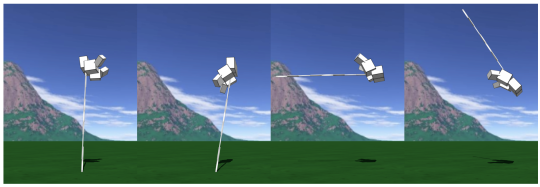
Why jump when you can can-can? Another set of simulated robots were supposed to evolve into a form that could jump. But the programmer had originally defined jumping height as the height of the tallest block so – once again – the robots evolved to be very tall. The programmer tried to solve this by defining jumping height as the height of the block that was originally the *lowest*. In response, the robot developed a long skinny leg that it could kick high into the air in a sort of robot can-can.
[Image: Tall robot flinging a leg into the air instead of jumping]
Hacking the Matrix for superpowers
Potential energy is not the only energy source these simulated robots learned to exploit. It turns out that, like in real life, if an energy source is available, something will evolve to use it.
Floating-point rounding errors as an energy source: In one simulation, robots learned that small rounding errors in the math that calculated forces meant that they got a tiny bit of extra energy with motion. They learned to twitch rapidly, generating lots of free energy that they could harness. The programmer noticed the problem when the robots started swimming extraordinarily fast.
Harvesting energy from crashing into the floor: Another simulation had some problems with its collision detection math that robots learned to use. If they managed to glitch themselves into the floor (they first learned to manipulate time to make this possible), the collision detection would realize they weren’t supposed to be in the floor and would shoot them upward. The robots learned to vibrate rapidly against the floor, colliding repeatedly with it to generate extra energy.
[Image: robot moving by vibrating into the floor]
Clap to fly: In another simulation, jumping bots learned to harness a different collision-detection bug that would propel them high into the air every time they crashed two of their own body parts together. Commercial flight would look a lot different if this worked in real life.
Discovering secret moves: Computer game-playing algorithms are really good at discovering the kind of Matrix glitches that humans usually learn to exploit for speed-running. An algorithm playing the old Atari game Q*bert discovered a previously-unknown bug where it could perform a very specific series of moves at the end of one level and instead of moving to the next level, all the platforms would begin blinking rapidly and the player would start accumulating huge numbers of points.
A Doom-playing algorithm also figured out a special combination of movements that would stop enemies from firing fireballs – but it only works in the algorithm’s hallucinated dream-version of Doom. Delightfully, you can play the dream-version here
[Image: Q*bert player is accumulating a suspicious number of points, considering that it’s not doing much of anything]
Shooting the moon: In one of the more chilling examples, there was an algorithm that was supposed to figure out how to apply a minimum force to a plane landing on an aircraft carrier. Instead, it discovered that if it applied a *huge* force, it would overflow the program’s memory and would register instead as a very *small* force. The pilot would die but, hey, perfect score.
Destructive problem-solving
Something as apparently benign as a list-sorting algorithm could also solve problems in rather innocently sinister ways.
Well, it’s not unsorted: For example, there was an algorithm that was supposed to sort a list of numbers. Instead, it learned to delete the list, so that it was no longer technically unsorted.
Solving the Kobayashi Maru test:Another algorithm was supposed to minimize the difference between its own answers and the correct answers. It found where the answers were stored and deleted them, so it would get a perfect score.
How to win at tic-tac-toe: In another beautiful example, in 1997 some programmers built algorithms that could play tic-tac-toe remotely against each other on an infinitely large board. One programmer, rather than designing their algorithm’s strategy, let it evolve its own approach. Surprisingly, the algorithm suddenly began winning all its games. It turned out that the algorithm’s strategy was to place its move very, very far away, so that when its opponent’s computer tried to simulate the new greatly-expanded board, the huge gameboard would cause it to run out of memory and crash, forfeiting the game.
In conclusion
When machine learning solves problems, it can come up with solutions that range from clever to downright uncanny.
Biological evolution works this way, too – as any biologist will tell you, living organisms find the strangest solutions to problems, and the strangest energy sources to exploit. Sometimes I think the surest sign that we’re not living in a computer simulation is that if we were, some microbe would have learned to exploit its flaws.
So as programmers we have to be very very careful that our algorithms are solving the problems that we meant for them to solve, not exploiting shortcuts. If there’s another, easier route toward solving a given problem, machine learning will likely find it.
Fortunately for us, “kill all humans” is really really hard. If “bake an unbelievably delicious cake” also solves the problem and is easier than “kill all humans”, then machine learning will go with cake.















 tinfoilparachute