Highway 80, the only road to Tybee Island, Ga., in June. High tides are forcing the road to close several times a year. Credit Stephen B. Morton for The New York Times
Excerpt:
For decades, as the global warming created by human emissions caused land ice to melt and ocean water to expand, scientists warned that the accelerating rise of the sea would eventually imperil the United States’ coastline.
Now, those warnings are no longer theoretical: The inundation of the coast has begun. The sea has crept up to the point that a high tide and a brisk wind are all it takes to send water pouring into streets and homes.
Federal scientists have documented a sharp jump in this nuisance flooding — often called “sunny-day flooding” — along both the East Coast and the Gulf Coast in recent years. The sea is now so near the brim in many places that they believe the problem is likely to worsen quickly. Shifts in the Pacific Ocean mean that the West Coast, partly spared over the past two decades, may be hit hard, too.
These tidal floods are often just a foot or two deep, but they can stop traffic, swamp basements, damage cars, kill lawns and forests, and poison wells with salt. Moreover, the high seas interfere with the drainage of storm water.
Local governments, under pressure from annoyed citizens, are beginning to act. Elections are being won on promises to invest money to protect against flooding. Miami Beach is leading the way, increasing local fees to finance a $400 million plan that includes raising streets, installing pumps and elevating sea walls.
But the local leaders say they cannot tackle this problem alone. They are pleading with state and federal governments for guidance and help, including billions to pay for flood walls, pumps and road improvements that would buy them time.
Yet Congress has largely ignored these pleas, and has even tried to block plans by the military to head off future problems at the numerous bases imperiled by a rising sea. A Republican congressman from Colorado, Ken Buck, recently called one military proposal part of a “radical climate change agenda.”
The gridlock in Washington means the United States lacks not only a broad national policy on sea-level rise, it has something close to the opposite: The federal government spends billions of taxpayer dollars in ways that add to the risks, by subsidizing local governments and homeowners who build in imperiled locations along the coast.
As the problem worsens, experts are warning that national security is on the line. Naval bases, in particular, are threatened; they can hardly be moved away from the ocean, yet much of their land is at risk of disappearing within this century.
Water from a tidal stretch of the Potomac River flooded Old Town Alexandria in Virginia during high tides in early June. Credit Gabriella Demczuk for The New York Times
At the City Market in Charleston, S.C., one of the most popular spots in town, shoppers dodged seawater that bubbled up from storm drains during high tide in June. Credit Hunter McRae for The New York Times
Climate change denial should be equated with yelling “fire” in a crowded movie theater and have free-speech protections revoked accordingly.
If Hillary gets elected, we might – just might- get Supreme Court justices who would agree with that.
But that’s how it is when you start wanting to have things. Now, I just look at them, and when I go away I carry them in my head. Then my hands are always free, because I don’t have to carry a suitcase.
This morning for a moment it was so quiet that I could hear the rain and the wind in the leaves on the way to the subway and made me wish for it to be all there was – the wind and the rain in the leaves. But then trucks and cars came back to life from the traffic light.
We can have democracy in this country,or we can have great wealth concentrated in the hands of a few. But we can’t have both.
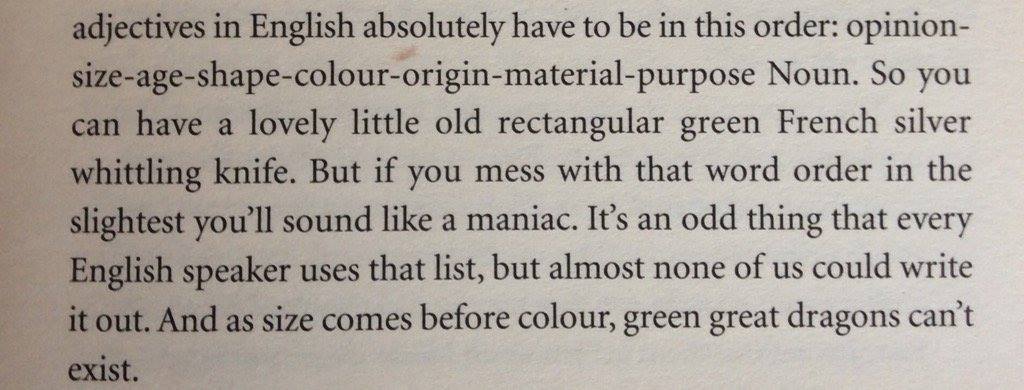
Is this true? The best thing about having a blog that follow many English speakers (and surely many philologists and students of similar areas) is that you can consult directly to them. So… It’s true or a joke? Thanks in advance! (8(º)
So it’s true!! Thanks to everyone of you for your highly reliable quick enlightening responses 😉
I hereby renounce constructing phrases with more than three adjectives (the previous sentence was the last one, and I’m not even sure if it is correct). :pp
Ec.
thoroughly exhausted after this “long weekend”.
Got sick with cold, then poor L got sick and feverish – meaning noone got to sleep – meaning being on the receiving end of snappiness and delirium and eggshell walks. Drive to Boston and back, thrown in for a good measure was really unnecessary, though another pharmacy run, at 4am this time, was.
Have a meeting tomorrow that I am not allowed to miss, R has a deadline and can’t take off, L’s daycare won’t take babies with fever for obvious reasons.
What do people do in this case?
Pharmacy run
if I am keeping this blog, I should just make it about clouds and sleep.






 tinfoilparachute