https://bandcamp.com/stream_redirect?enc=mp3-128&track_id=4264274502&ts=1544037518&t=0921afd75a12aa602e5fc610e4d836c80250e8c1?plead=please-dont-download-this-or-our-lawyers-wont-let-us-host-audio
http://bandcamp.com/EmbeddedPlayer/size=medium/bgcol=ffffff/linkcol=0687f5/notracklist=true/transparent=true/track=4264274502/
I will just say it here since I can’t really say it anywhere
else – if there is one thing I am beginning to hate, it’s tribalism. I actually
went home to my parents on Tuesday to help with tech issues that accumulated in
a month, and it was poor timing on my part because I was treated to my father
clapping and cheering at the TV during the trump speech, like it was a favorite sports team scoring a goal, and cursing at Kennedy’s
response before shutting it off halfway, and couldn’t escape it downstairs where
the same speech was synchronously translated, jubilantly and accompanied with inaccurate
live commentary, on Russian TV channel ( going, literally, like this: “…I will
protect the Second Amendment … – that’s the one about the freedom of religion- … ” ).
What’s even worse is that what is supposed to be “our side”
is not that much better either, playing into the most divisive kind of identity
politics that cost us the election last time, and will continue to do so even
if our democracy somehow miraculously survives, which seems less likely with each passing day.
I’ve never felt this rootless.
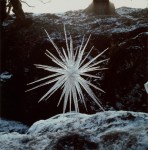

Andy Goldsworthy, Ice Star and Ice Sphere, Scaur Water, Penpont, Dumfriesshire, 1987. Colour photography. Via Government Art Collection © Andy Goldsworthy
In another life, I want to go around the world and see every single thing that Goldsworthy made.
a piece of cardboard that L found inside his pastry snack made in a former soviet country – I will call it a gift from the Old Country. He called it a “seed”.



‘Lumen Type’
These beautifully ethereal letters have been created with water droplets and light.
Inspired by the reflections of car headlights on a road spattered with rain drops they are the experiments of Russian designer Ruslan Khasanov.
Each letter was has been created from water droplets produced with a syringe that are then illuminated from different angles and viewed through a lens.
A free, teacher-less university in France is schooling thousands of future-proof programmers
If all of the metrocard machines are “temporarily” not accepting credit or debit cards, I will “temporarily” not be paying my fare. I don’t walk around with $121 in cash for the monthly, and since MTA cut the position of token booth clerk at our unimportant station (and not cleaning human excrement accumulating on the stairs for days), helpful fellow passengers will keep the emergency-door open for me and others who go on a fare strike.
The notion of an event or state of being without cause drives hard against the grain of science. For centuries, scientists have attempted to explain all events as the logical consequence of prior events. Page argues that at the origin of our universe — whether in the Two-Headed Time model or in the universe-out-of-nothing model — there was no clear distinction between cause and effect. If causality can dissolve in the quantum haze of the origin of the universe, [Don] Page and other physicists note, there is reason to question its solidity even in the world that we live in, long after the Big Bang, which is surely part of the same reality. “Causality within the universe is not fundamental,” said Page. “It is an approximate concept derived from our experience with the world.” Strict causality could be an illusion, a way for our brains, and our science, to make sense of the world. But without strict causality, how can we take responsibility for our actions? A crack in the marble foundation of causality could send tremors into philosophy, religion, and ethics.
Quantum cosmology has led us to questions about the fundamental aspects of existence and being, questions that most of us rarely ask. In our short century or less, we generally aim to create a comfortable existence within the tiny rooms of our lives. We eat, we sleep, we get jobs, we pay the bills, we have lovers and children. Some of us build cities or make art. But if we have the luxury of true mental freedom, there are larger concerns to be found. Look at the sky. Does space go on forever, to infinity? Or is it finite but without boundary or edge, like the surface of a sphere? Either answer is disturbing, and unfathomable. Where did we come from? We can follow the lives of our parents and grandparents and their parents backward in time, back and back through the generations, until we come to some ancestor ten thousand years in the past whose DNA remains in our body. We can follow the chain of being even further back in time to the first humans, and the first primates, and the one-celled amoebas swimming about in the primordial seas, and the formation of the atmosphere, and the slow condensation of gases to create Earth. It all happened, whether we think about it or not. We quickly realize how limited we are in our experience of the world. What we see and feel with our bodies, caught midway between atoms and galaxies, is but a small swath of the spectrum, a sliver of reality.
What Came Before the Big Bang? Alan Lightman.
“Our posturings, our imagined self-importance, the delusion that we have some privileged position in the Universe, are challenged by this point of pale light. Our planet is a lonely speck in the great enveloping cosmic dark. In our obscurity, in all this vastness, there is no hint that help will come from elsewhere to save us from ourselves.” – Carl Sagan.
(via kuanios)
I find the concept of nonlinear time (and the implications it has on free will and fate) endlessly fascinating ever since reading that sci fi story about the aliens who could experience all events at once – the one I hear The Arrival is made after, but that I haven’t seen.
 tinfoilparachute