fuckyeahfluiddynamics:

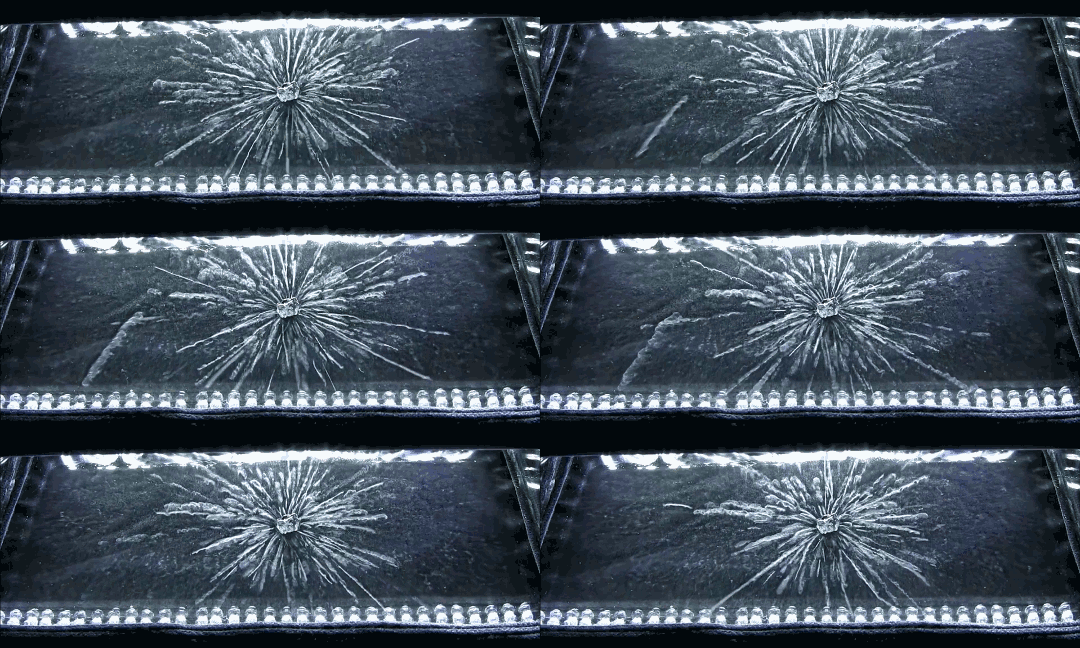
We’re used to radiation being invisible. With a Geiger counter, it gets turned into audible clicks. What you see above, though, is radiation’s effects made visible in a cloud chamber. In the center hangs a chunk of radioactive uranium, spitting out alpha and beta particles. The chamber also has a reservoir of alcohol and a floor cooled to -40 degrees Celsius. This generates a supersaturated cloud of alcohol vapor. When the uranium spits out a particle, it zips through the vapor, colliding with atoms and ionizing them. Those now-charged ions serve as nuclei for the vapor, which condenses into droplets that reveal the path of the particle. The characteristics of the trails are distinct to the type of decay particle that created them. In fact, both the positron and muon were first discovered in cloud chambers! (Image credit: Cloudylabs, source)

Just imagine living in a world without mirrors. You’d dream about your face and imagine it as an outer reflection of what is inside you. And then, when you reached forty, someone put a mirror before you for the first time in your life. Imagine your fright! You’d see the face of a stranger. And you’d know quite clearly what you are unable to grasp: your face is not you.

Milan Kundera, Immortality (via quotespile)

climateadaptation:

modfarm:

EPA Chief Met With Dow’s CEO Before Deciding Not To Ban Dow’s Dangerous Pesticide

The Trump administration and agribusiness are like THIS. *entwines fingers so hard that all the bones break*

Americans elected them though…

…technically, a small percentage of Americans did…

Let’s also not forget the strong push from AgriCanada, the Canadian counterpart of USDA, to roll back these regulations.
More background here, which included the 2015 court ruling that started it all:
Http://bit.ly/2s3plfq

themindmovement:

“Sometimes, when one is moving silently through such an utterly desolate landscape, an overwhelming hallucination can make one feel that oneself, as an individual human being, is slowly being unraveled. The surrounding space is so vast that it becomes increasingly difficult to keep a balanced grip on one’s own being. The mind swells out to fill the entire landscape, becoming so diffuse in the process that one loses the ability to keep it fastened to the physical self. The sun would rise from the eastern horizon, and cut it’s way across the empty sky, and sink below the western horizon. This was the only perceptible change in our surroundings. And in the movement of the sun, I felt something I hardly know how to name: some huge, cosmic love.”

― Haruki Murakami, The Wind-Up Bird Chronicle

Photo: themindmovement, 2015

I think they correlate to certain words in your posts and tags. This is why I avoid spelling out swear words. They might also run analytics on how often you post or reblog. I’m sure there are whole discussion groups in the darkweb on how to write these vile things, which I have no time or inclination to research.

What I don’t understand is why go through such efforts. Really, what do they stand to gain if they get you to interact with them?

Does anyone know?

Notional life is the life encouraged by government, mass education and the mass media. Each of these powerful agencies couples an assumption of its own importance with a disregard for individuality. Freedom of choice is the catch phrase but streamlined homogeneity is the objective. A people who think for themselves are hard to control and what is worse, in a money culture, they may be sceptical of product advertising. Since our economy is now a consumer economy, we must be credulous and passive. We must believe that we want to earn money to buy things that we don’t need. The education system is not designed to turn out thoughtful individualists, it is there to get us to work. When we come home exhausted from the inanities of our jobs we can relax in front of the inanities of the TV screen. This pattern, punctuated by birth, death and marriage and a new car, is offered to us as real life. Children who are born into a tired world as batteries of new energy are plugged into the system as soon as possible and gradually drained away. At the time when they become adult and conscious they are already depleted and prepared to accept a world of shadows. Those who have kept their spirit find it hard to nourish it and between the ages of twenty and thirty, many are successfully emptied of all the resistance. I do not think it an exaggeration to say that most of the energy of most of the people is being diverted into a system which destroys them. Money is no antidote. If the imaginative life is to be renewed it needs its own coin.

Jeanette Winterson, ‘Imagination and Reality’, Art Objects (via stoicremains)

I only saw this quote, and sad and depressing as it sounds, this is probably exactly where we would be as we reach our current stage in Maslow’s hierarchy.
When we are relatively healthy, have shelter, food and safety taken care of, have a semblance of social belonging, we inevitably start to look for self respect and self actualization.
We can fulfill some of it through altruism and helping others, some of us have religion that can give everything meaning, and some are lucky enough to have built something that makes them proud and outlasts themselves, we can strive to better ourselves and those we care about, we can build better things, and share them, but it will never be perfect.

On reading John Kay’s Obliquity

stoweboyd:

I am reading John Kay’s Obliquity with deep enjoyment, and the fragment below may demonstrate why.

Obliquity, as Kay defines it, ‘describes the process of acheiving complex objectives indirectly’. The idea is derived from the philosophic principal that trying to find happiness directly seems to fail, but those that work toward that end obliquely – like finding something worth doing with your life, and doing it – arrive at happiness without striving for it. As Victor Frankly said,

Happiness cannot be pursued; it must ensue, and it only does so as the unintended side effect of one’s personal dedication to a cause greater than oneself or as the by-product of one’s surrender to a person other than oneself.

The more a man tries to demonstrate his sexual potency or a woman her ability to experience orgasm, the less they are able to succeed. Pleasure is, and must remain, a side-effect or by-product, and is destroyed and spoiled to the degree to which it is made a goal in itself.

The fragment below, from the first chapter, preceeds from a characterization of the failures of Le Corbusier’s modernism, a top-down, rationalist attempts to squelch all evolution from designing places to live. That’s a jumping off point to a discussion of Hammer and Champy’s reengineering notions:

John Kay, Obliquity

An oblique approach recognises that what we want from a home, or a community, has many elements. We will succeed in specifying fully what they are, and to the extent we do, we discover that they are often incompatible and inconsistent. The interactions between a home and its occupants, or between the people who make up a community, are complex and uncertain. Experience of both previous and current problems guides the search for answers. Many people contribute to the outcome, and even after that outcome has been realised none of them necessarily holds a full understanding of how Notre Dame was built, by many hands over several centuries.

Reengineering the Corporation by Michael Hammer and James Champy was one of the bestselling business books of the 1990s, and Hammer and Champy were as radical in inspiration as Le Corbusier:

These ideas, we believe, are as important to business today as Adam Smith’s ideas were to the entrepreneurs and managers of the last two centuries. Reengineering means asking the question “If I were re-creating this company today, given what I know and given current technology, what would it look like?” Reengineering a Company means tossing aside old systems and starting over. It involves going back to the beginning and inventing a better way of doing work.

Re-engineering was the substitution of design for adaptation and discovery – preferring the direct to the oblique. The demand for such a direct approach found a manifesto in Lenin’s What Is to Be Done?“*The future Russian leader argued that political and economic reform could be achieved only if imposed by a close-knit revolutionary cadre with a single vision. And although Le Corbusier was as far to the right as Lenin was to the left, and Hammer and Champy were certainly no Marxists, Le Corbusier would have approved wholeheartedly. Re-engineering was the essence of his conception.

It has been drawn up by serene and lucid minds. It has taken account of nothing but human truths. It has ignored all Current regulations, all existing usages and channels.

I cannot read such words without thinking of Pol Pot, Who proclaimed that the Khmer Rouge takeover of Cambodia marked year zero, when everything began anew (two centuries earlier, the French Revolutionaries made the same claim). A reign of terror followed in both cases. Pol Pot not only destroyed the fabric of society, he killed or caused the deaths of some 1.5 million of his countrymen.

Hammer and Champy are not bad men. Perhaps they do really mean what they appear to say, and re-engineering should be seen as a thought experiment, a way of asking questions about the relevance of current practice, not a literal prescription. Still, Lenin and Le Corbusier did mean what they said. What they believed to be the height of rationality, the creation of ‘serene and lucid minds’, was not rational at all, because based on a false and oversimplified picture of the world. The environment – social, commercial, natural – in which we operate changes over time and as we interact with it. Our knowledge of that complex environment is necessarily piecemeal and imperfect. And so objectives are generally best accomplished obliquely rather than directly.

I’m certain that I will write a longer form article on these ideas, especially since the current mania regarding ‘designing culture’ that has taken hold in the shortcircuited world of startup entrepreneurialism. It’s now a given – not subject to discussion or reflection – that

  1. organizational culture is an object, a thing subject to design and crafting,
  2. leadership should decide what the business culture ought to be,
  3. and impose that idea on the organization like an architect designing and constructing an airport, a hospital, or a shopping mall.

More to follow.

“Objectives are generally best accomplished obliquely than directly.”

This is what I mean when I say that I disagree with radicals (whether they are Le Corbusier, Lenin, Bannon, or a variety of neo-Marxists) and I hate revolutions.