“How Facebook’s tentacles reach further than you think”

imadeit-davidjanes:


He reels off the familiar, but still staggering, numbers: the barely teenage Silicon Valley firm stores some 300 petabytes of data, boasts almost two billion users, and raked in almost $28bn (£22bn) in revenues in 2016 alone.

The data will remain in the hands of one company. Even if its current leaders are responsible and trustworthy, what about those in charge in 20 years?

Facebook plays to our base psychological impulses by valuing popularity above all else.

“How Facebook’s tentacles reach further than you think”

I need more (or any) friends here… that guy I got to hang out in Cape Town reminded me of what’s possible.
We are all just too wrapped into ourselves and our complicated lives here. I don’t like having to get on my friends’ calendars with 2 month notice.

Sanofi rejects U.S. Army request for ‘fair’ pricing for a Zika vaccine – PBS

They mentioned on the radio this morning that U.S. Army developed Zika vaccine, in literal one sentence, and then moved on to their continued in depth reporting of Horrible News ™.

What this tells me:
– media will always ignore or downplay good news, and media that I choose or try to trust is no different
– US Army is apparently in the business of developing vaccines for poor-country diseases that commercial companies don’t care about
– government research is superior to the market driven research
– positive outcomes can happen even when our government spending priorities are grossly askew. So, not all is lost under trump

After I tried to find more on it I couldn’t believe that the French company that they gave the “free” research (funded with *my* taxes!) and asked to make the vaccine is again only thinking about maximizing their profit!

Sanofi rejects U.S. Army request for ‘fair’ pricing for a Zika vaccine – PBS

Her fiancé is an astrophysicist. He is quitting to join a fintech startup as a data scientist.

Skill sets are similar.

I know it’s not a zero sum, but I can’t help it but feel that we as humanity are collectively losing while private enterprise is gaining.

prostheticknowledge:

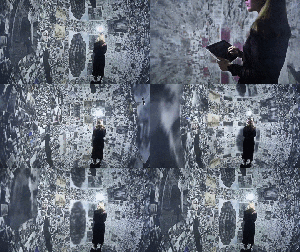
Archive Dreaming

Installation by Refik Anadol and
Mike Tyka explores data and machine learning, letting you examine 1.7 million documents, their information and connections, but when idle it visualizes ‘dreams’ of documents with neural networks:

Commissioned to work with SALT Research collections, artist Refik
Anadol employed machine learning algorithms to search and sort relations
among 1,700,000 documents. Interactions of the multidimensional data
found in the archives are, in turn, translated into an immersive media
installation. Archive Dreaming, which is presented as part of The Uses
of Art: Final Exhibition with the support of the Culture Programme of
the European Union, is user-driven; however, when idle, the installation
“dreams” of unexpected correlations among documents. The resulting
high-dimensional data and interactions are translated into an
architectural immersive space.

Shortly after receiving the commission, Anadol was a resident artist
for Google’s Artists and Machine Intelligence Program where he closely
collaborated with Mike Tyka and explored cutting-edge developments in
the field of machine intelligence in an environment that brings together
artists and engineers. Developed during this residency, his
intervention Archive Dreaming transforms the gallery space on floor -1
at SALT Galata into an all-encompassing environment that intertwines
history with the contemporary, and challenges immutable concepts of the
archive, while destabilizing archive-related questions with machine
learning algorithms.

In this project, a temporary immersive architectural space is created
as a canvas with light and data applied as materials. This radical
effort to deconstruct the framework of an illusory space will transgress
the normal boundaries of the viewing experience of a library and the
conventional flat cinema projection screen, into a three dimensional
kinetic and architectonic space of an archive visualized with machine
learning algorithms. By training a neural network with images of
1,700,000 documents at SALT Research the main idea is to create an
immersive installation with architectural intelligence to reframe
memory, history and culture in museum perception for 21st century
through the lens of machine intelligence.

More Here